Muslim Brotherhood spokesman
Gehad El-Haddad told CNN the ousted president, Mohamed Morsy, was under
house arrest at the presidential Republican Guard headquarters in
Cairo; the military has not commented on Morsy's whereabouts.
Morsy has refused an
offer by the armed forces to leave Egypt for Qatar, Turkey or Yemen, the
state-run newspaper Al Ahram reported Thursday. The report said he had
refused to step down voluntarily and that his speech on Wednesday --
prior to his ouster -- represented a "flagrant challenge to its
authority" and a "declaration of confrontation with it."
A spokesman for Morsy's
Freedom and Justice Party said that what started as a military coup was
"turning into something much more" than that.
In an interview in Cairo,
El-Haddad cited the arrests as "very, very questionable attempts by the
military to dismantle the Brotherhood."
He added, "This is a military coup that's establishing an oppressive new regime under the whitewashed face of the old regime."
The military should not
take political sides, he said, adding that he had had no direct
communications with Morsy, "But there are sympathizers inside the
military who are giving us pieces of information, primarily to other
Muslim Brotherhood leaders, that have relayed it to me."
The former chairman of
the Muslim Brotherhood, Mahdi Aakef, and his bodyguards were arrested
Thursday in Cairo with four weapons in their possession, according to
the state-run Middle East News Agency, which cited security sources.
And Muslim Brotherhood
supreme leader Mohamed Badei and the former supreme leader Mohamed Mahdi
Akef have been arrested, Egyptian state broadcaster Nile TV said
Thursday.
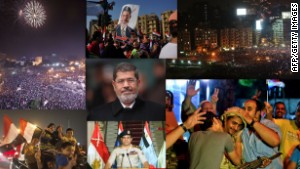 What comes next in Egypt?
 Egypt: Battle over the word 'coup'
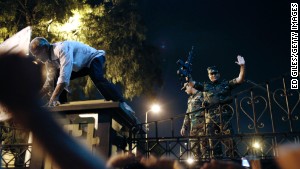 Activist: People held hostage by Morsy
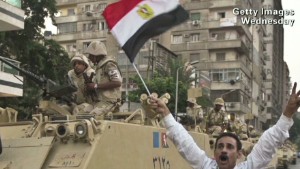 White House watching crisis in Egypt
Arrest warrants have
been issued for Badei's deputy, Khairat el-Shater, and other Brotherhead
leaders on charges of inciting the killing of peaceful protesters in
front of Brotherhood headquarters in Cairo's Moqattam neighborhood.
Police are seeking another 300 members of the Muslim Brotherhood, the state-run newspaper Al-Ahram reported.
Morsy and eight other
former government officials -- all Brotherhood members -- had been
placed on a "no-fly" list and were to be charged with "insulting the
judicial authorities and its men," state-run EgyNews reported.
On Wednesday, police
closed the studios of pro-Muslim Brotherhood television stations Misr
25, The People and al-Hafez and arrested some of the journalists,
state-run Al-Ahram newspaper reported.
On its website, the
Muslim Brotherhood declared "our unequivocal rejection of the military
coup against the elected president and the will of the nation and refuse
to participate in any action with the authority that stole the power
and dealt violently with peaceful demonstrators."
It added, "Mohamed
Morsy, president of Egypt, stresses that the measures that were
announced by the General Command of the Armed Forces represent a
full-fledged military coup which is unacceptable by every free person."
It called on demonstrators to show restraint.
The moves against the
organization came as an uncertain new political order began to take
shape with the swearing in of an interim president as well as the
constitution's suspension on Wednesday.
The state-run Al-Ahram
News reported that Egypt's stock market surged 7% in the first hours of
trading Thursday to a near two-month high.
The coup divided the
hundreds of thousands of people who had taken to the streets across
Egypt in recent days to defend or criticize Morsy's government.
It also raised questions
about what will happen to Morsy and his supporters, who insist he
remains the country's legitimate leader; whether violence blamed for the
deaths Wednesday of at least 32 people will spread; whether democracy
has a chance in Egypt.
But the Tamarrod
movement that had sought Morsy's ouster was moving on. It said in a
tweet that it had nominated Mohamed ElBaradei, an opposition leader, to
become prime minister.
The conflicting views,
the threat of more violence, possible divisions among the anti-Morsy
coalition and Egypt's economic woes represent major obstacles to a
smooth transition, said Hani Sabra,
director of the Middle Eastern arm of the Eurasia Group, a U.S.-based
political risk research and consulting firm. "I don't think that the
military's so-called road map is actually going to move smoothly. I
think there are a lot of challenges it faces."
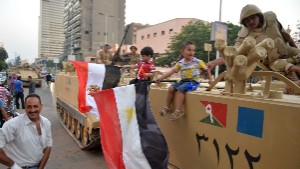
The huge crowds that had
celebrated Morsy's ouster Wednesday night with horns, cheering,
fireworks had thinned hours later. On Thursday, the atmosphere in
Cairo's Tahrir Square was calm and celebratory. Crowds cheered as
military helicopters flew overhead. Women pushed baby strollers,
children had their faces painted, music played and people danced.
Swearing in
Morsy, a
Western-educated Islamist elected a year ago, "did not achieve the goals
of the people" and failed to meet the generals' demands that he share
power with his opposition, Egypt's top military officer, Gen.
Abdel-Fatah El-Sisi, said Wednesday in a televised speech to the nation.
Adly Mansour, head of the country's Supreme Constitutional Court, was sworn in Thursday as interim president in Cairo.
At the ceremony, Mansour
said the Egyptian people had given him the authority "to amend and
correct" the revolution that toppled Hosni Mubarak in 2011.
Following a decree last month by Morsy, Mansour had become head of the court just two days earlier.
Until new elections, to
be held at an unspecified date, Mansour will have the power to issue
constitutional declarations, El-Sisi said.
The Egyptian military
has dominated the country for six decades and took direct power for a
year and a half after Mubarak's ouster.
Morsy's approval ratings
plummeted after his election in June 2012 as his government failed to
keep order or revive Egypt's economy.
Morsy's opponents
accused him of authoritarianism and forcing through a conservative
agenda, and on Monday the military gave him 48 hours to order reforms.
As the deadline neared
Wednesday, he offered to form an interim coalition government to oversee
parliamentary elections and revise the constitution, which was enacted
in January. But those actions failed to satisfy the generals.
Conflicting responses
The army's move against
Morsy and the Muslim Brotherhood, the long-repressed political movement
that propelled him to office, provoked wildly conflicting reactions.
In Tahrir Square, the
epicenter of two Egyptian upheavals, a vast gathering of Morsy's
opponents erupted in jubilation and fireworks at El-Sisi's announcement
Wednesday night.
"The crowd walked up to the barricades and started banging on them using rocks, sticks and even bare hands," said Sultan Zaki Al-Saud in a CNN iReport. "It sounded like thunder as the hollow barricades rang with every blow."
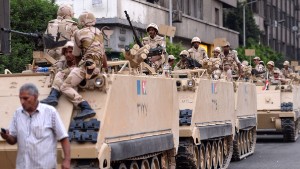 Analyst: Morsy called military's bluff
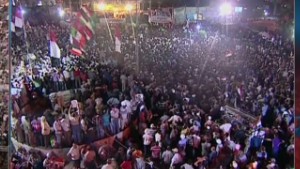 Obama to Egypt: Return to civilian rule
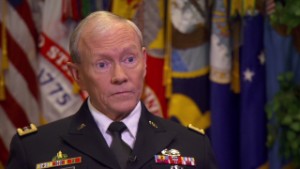 Gen. Dempsey: World needs a stable Egypt
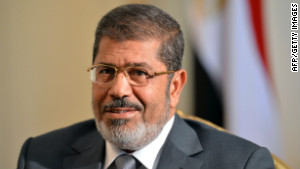 Egypt begins post-Morsy era
During his time in office, Morsy had squared off against Egypt's judiciary, the media, the police and even artists.
Egyptians are frustrated
with rampant crime and a struggling economy. Unemployment remains high,
food prices are rising and there are frequently electricity cuts and
long fuel lines.
ElBaradei, the former
head of the International Atomic Energy Agency and a leading opposition
figure, said the plans announced Wednesday by the military represented
"a correction for the way of the revolution" that drove Mubarak from
office.
But Abdoul Mawgoud
Dardery, a former member of parliament allied with Morsy, criticized the
military's decision to take matters into its hands.
"I don't know how can
anyone with common sense support a military coup in a democracy," he
said. Egyptians "will never recognize a coup d'etat."
Outside observers echoed that concern.
"Popular protests are
the sign of a robust democracy. But the change in an elected government
should be at the ballot box, not through mob violence," said Ed Husain, a
senior fellow for Middle Eastern studies at the Council on Foreign
Relations.
Across the Nile River
from Tahrir Square, Morsy supporters chanted, "Down with military rule,"
and "The square has a million martyrs."
A pro-Morsy protester in Cairo predicted demonstrators would stay "until Mohamed Morsy is once again president of Egypt."
"We're not violent, but
at the end of the day we want peaceful change of power," El-Haddad, the
Muslim Brotherhood spokesman, told CNN's Anderson Cooper. "But if
democracy gets derailed every time that way, what other option is the
people left with?"
'The world is looking'
Morsy had remained defiant.
"The world is looking at
us today," he said Wednesday in a taped statement delivered to the
Arabic satellite network Al Jazeera. "We by ourselves can bypass the
obstacles. We, the sons of Egypt, the sons of this country -- this is
the will of the people and cannot be canceled."
Shortly after Morsy's
statement aired, Al Jazeera reported its Cairo studios had been raided
during a live broadcast and its presenter, guests and producers
arrested.
"A return to Mubarak-era
practices of mass arrests and politically motivated imprisonment of
Muslim Brotherhood leaders will have the worst possible effect on
Egypt's political future," said Human Rights Watch, the U.S.-based advocacy group.
Despite the moves
against the Brotherhood, the military suggested Thursday it would
protect the movement's members. The military said it would not allow any
attacks or intimidation against those who belong to an Islamic group,
state-run Nile TV reported.
But 32 people were
killed Wednesday in clashes in Egypt, officials told Nile TV. Hundreds
more were reported to have been injured.
The sporadic violence at
times pitted Morsy's supporters against the opposition and the
military, raising fears of spiraling unrest.
 Egyptian ambassador: This was not a coup
 People cheering after Morsy's ouster
 U.S. Embassy in Egypt evacuated
 Can Egypt's economy stabilize?
Concerns of a backlash
Some observers warned of an extremist backlash.
"The major lesson that
Islamists in the Middle East are likely to learn from this episode is
that they will not be allowed to exercise power, no matter how many
compromises they make in both the domestic and foreign policy arenas,"
said Mohammed Ayoob, Michigan State University professor emeritus of
international relations.
"This is likely to push a
substantial portion of mainstream Islamists into the arms of the
extremists who reject democracy and ideological compromise," Ayoob wrote in a CNN.com opinion piece.
President Barack Obama said the United States was "deeply concerned" by Morsy's removal and the suspension of the constitution.
He called upon the
military to hand over power to "a democratically elected civilian
government" but did not say it needed to be Morsy's.
At least three
high-level conversations took place between U.S. military officials and
their Egyptian counterparts in the past week, Pentagon officials said
Thursday.
The situation has created an uncomfortable policy scenario for the United States, which champions democratic principles.
Washington has supplied
Egypt's military with tens of billions of dollars in support and
equipment for more than 30 years. Under U.S. law, that support could be
cut off after a coup.
Obama said he had ordered "the relevant departments and agencies" to study how the change in power would affect U.S. aid.
The German government was more blunt in its assessment.
"This is a heavy setback
for democracy in Egypt," German Foreign Minister Guido Westerwelle
said. "It is very urgent for Egypt to return to constitutional order as
soon as possible."

No comments:
Post a Comment